

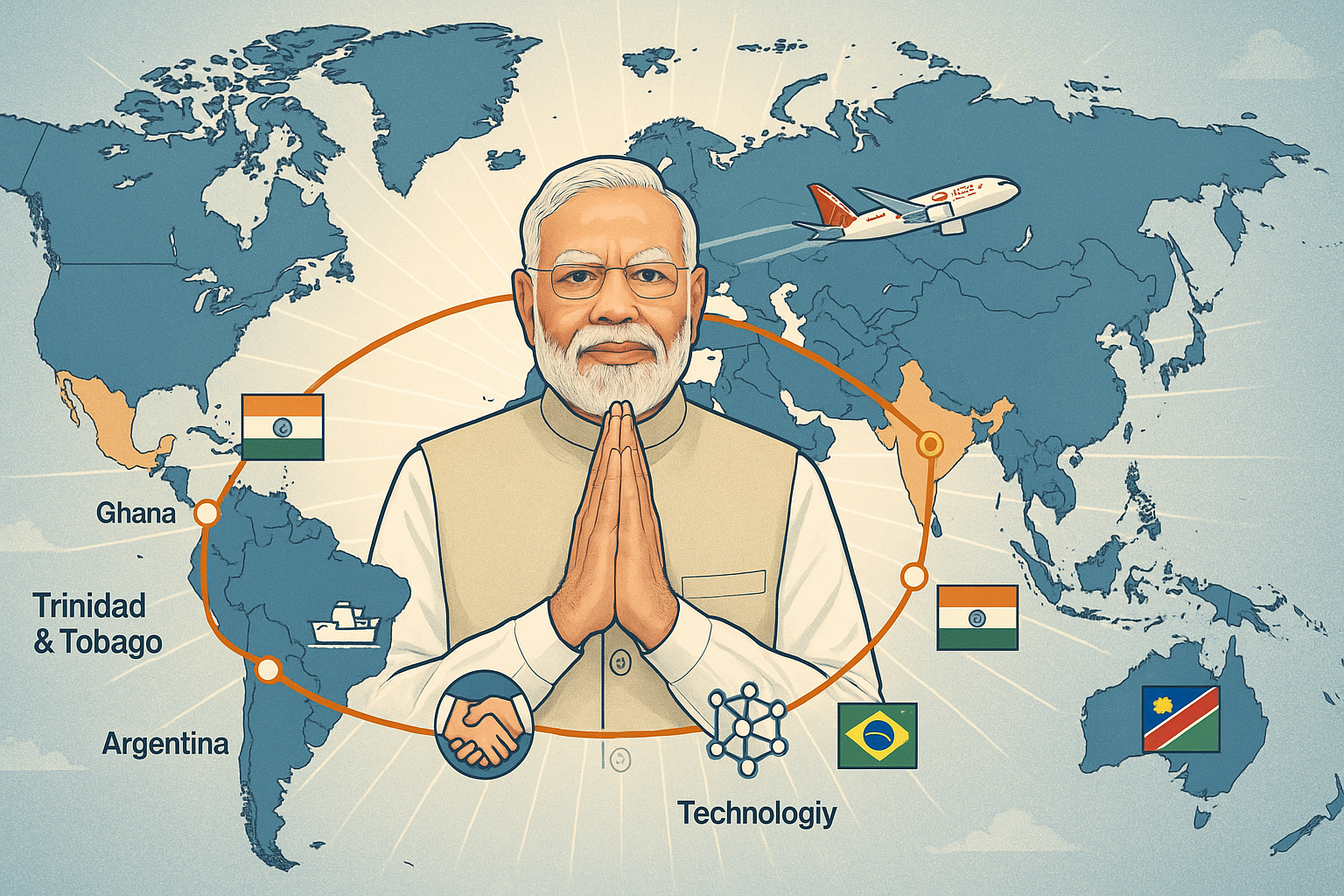
In the span of eight days, Prime Minister Narendra Modi is crossing three continents, addressing four parliaments, and shaking hands with leaders governing vastly different corners of the planet. This isn’t just a diplomatic marathon; it’s a high-stakes pivot. Imagine a chess player moving five key pieces across the board at once. The board is the new world order, and the pieces are nations in Africa, the Caribbean, and Latin America. The prize? A redefined role for India as the undisputed leader of the Global South.
As Prime Minister Narendra Modi embarks on a landmark five-nation tour—his longest in a decade—the world is watching. The journey, weaving through Ghana, Trinidad & Tobago, Argentina, Brazil, and Namibia from July 2nd to 9th, 2025, is more than a collection of bilateral meetings. It’s a calculated and audacious statement. At a time when global alliances are fracturing, can India build a new coalition of developing nations, stretching from the Atlantic coast of Africa to the resource-rich heart of South America? This tour is the ultimate test.
Turning Point 1: The Gateway to Africa – Accra, Ghana
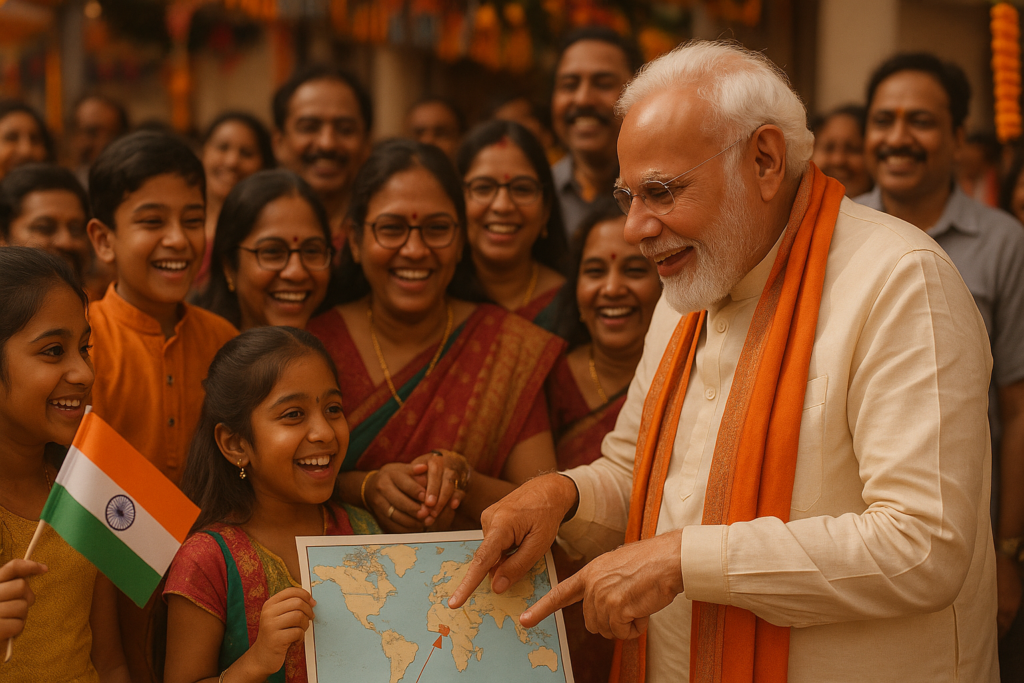
The tour began with a symbolic and powerful gesture. Landing in Accra, PM Modi was received by Ghanaian President John Dramani Mahama, marking the first bilateral visit by an Indian Prime Minister in over three decades. This was no routine diplomatic call.
- The Scene: The Jubilee House, Ghana’s presidential palace built with Indian assistance, became the backdrop for talks focused on creating a West African vaccine hub, securing agricultural partnerships, and deepening defense cooperation. The message was concrete: India is here to build and protect.
- The Credibility: In a significant honor, PM Modi will not only address the Ghanaian Parliament but also receive the “Companion of the Order of the Star,” Ghana’s highest state award. This isn’t just about friendship; it’s an acknowledgment of India’s growing influence.
- The Emotion: For the 15,000-strong Indian community in Ghana, the visit is a reaffirmation of their connection to their ancestral homeland, a bridge between two democracies.
Turning Point 2: A Kinship Rejuvenated – Port of Spain, Trinidad & Tobago
From Africa, the Prime Minister’s jet crossed the Atlantic to the Caribbean, a journey charged with history. The visit to Trinidad & Tobago coincides with the 180th anniversary of the arrival of the first Indian indentured laborers on the ship Fatel Razack.
- The Story: With nearly half its population of Indian descent, this leg of the tour is a powerful exercise in diaspora diplomacy. PM Modi is scheduled to meet President Christine Kangaloo and Prime Minister Kamla Persad-Bissessar, but the emotional core of the visit will be a large community diaspora event.
- What You Didn’t Know: The Speaker’s chair in Trinidad & Tobago’s Parliament was a gift from India, a tangible symbol of the shared democratic traditions that will be highlighted when PM Modi addresses a joint session.
- The Stakes: This visit, the first by an Indian PM since 1999, aims to rejuvenate what Modi called “the special bonds of ancestry and kinship,” translating deep cultural ties into modern partnerships in health, digital services, and renewable energy.
“This visit will provide an opportunity to rejuvenate the special bonds of ancestry and kinship that unite us.” – PM Narendra Modi
Turning Point 3: Tapping the ‘Lithium Triangle’ – Buenos Aires, Argentina
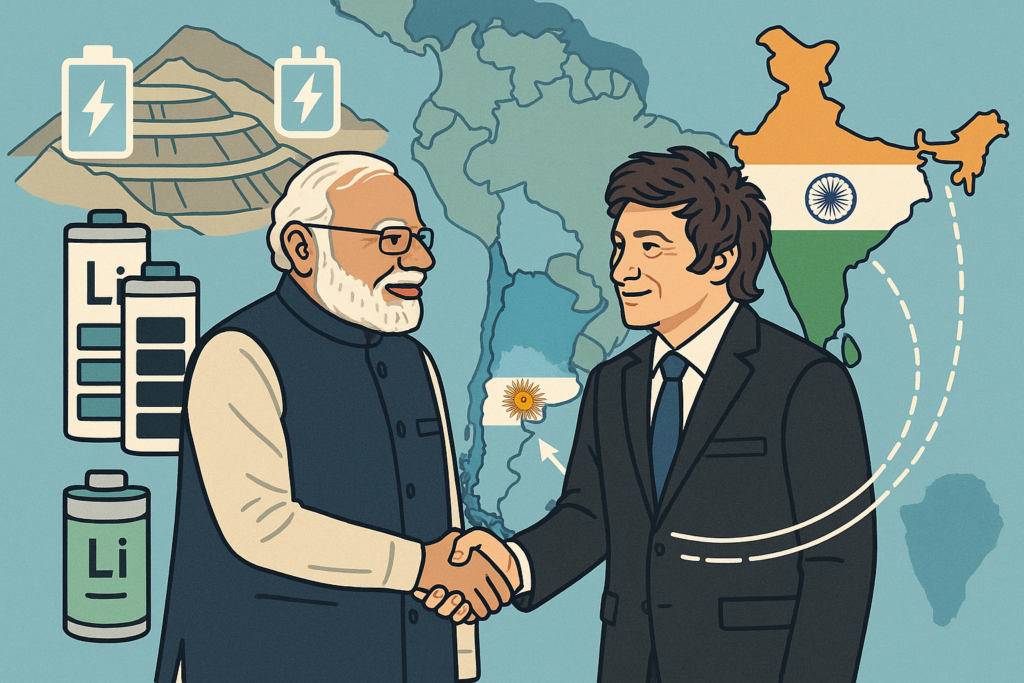
The narrative then shifts to the heart of Latin America, with a visit to Argentina that breaks a 57-year gap in bilateral prime ministerial visits. Here, the focus pivots sharply to economic and resource security.
- The Character: PM Modi’s meeting with Argentina’s new, reformist President, Javier Milei, is a study in contrasts but united by pragmatism.
- The Concrete Details: The agenda is packed with some of the 21st century’s most critical resources. Argentina, part of the “Lithium Triangle,” holds the key to India’s electric vehicle ambitions. Its vast shale oil and gas reserves in the Vaca Muerta field offer a crucial source for India’s energy needs. Discussions will center on giving Indian public-sector firms access to these vital assets.
- The Unexpected: As Argentina undergoes sweeping economic reforms, India is positioning itself as a key partner, offering expertise in defense manufacturing, space technology, and digital public infrastructure like UPI.
1-Minute Explainer: What is the “Global South”?
The “Global South” is a term used to describe a group of countries often characterized as developing, less-developed, or newly industrialized. These nations, primarily located in Africa, Asia, and Latin America, are increasingly working together to address shared challenges and amplify their collective voice on the world stage. India’s current foreign policy places a major emphasis on leading this diverse and influential bloc.
Turning Point 4: The Powerhouse and the Bloc – Rio & Brasília, Brazil
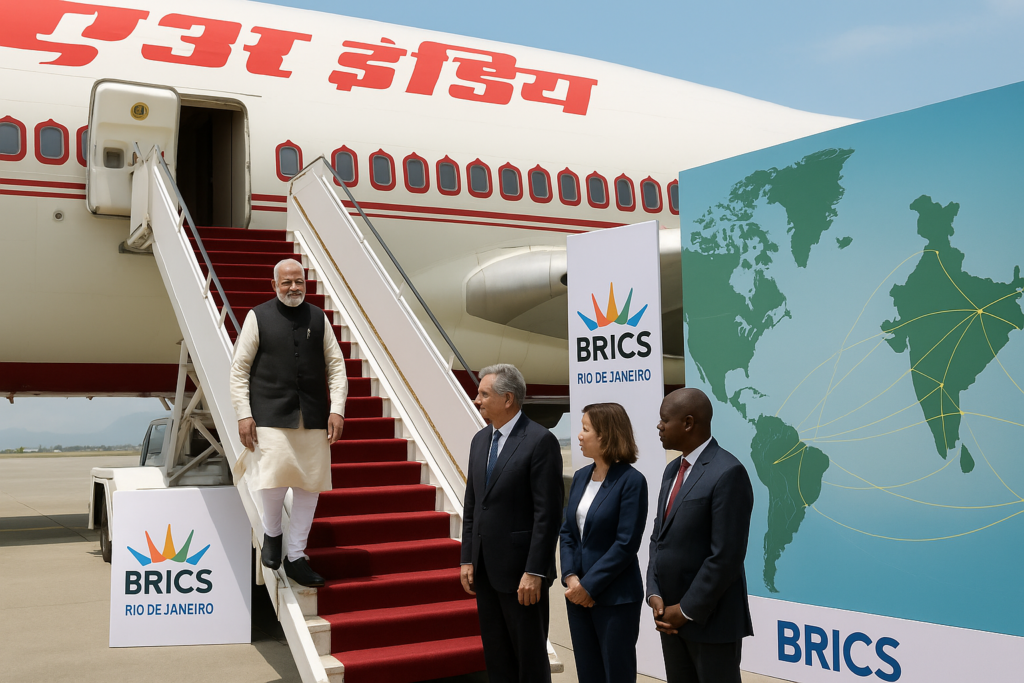
The tour’s centerpiece is Brazil, India’s largest trading partner in Latin America. The visit is twofold: a multilateral summit followed by a historic state visit.
- The Scene: In Rio de Janeiro, PM Modi will attend the 17th BRICS Summit. With the bloc now expanded, India’s role is more critical than ever in shaping a collective stance on global governance, terrorism, and climate action.
- The Significance: Following the summit, PM Modi will travel to Brasília for the first state visit by an Indian Prime Minister in nearly six decades. The meeting with President Luiz Inácio Lula da Silva is a crucial opportunity to align the priorities of two of the Global South’s most powerful voices.
Turning Point 5: From Cheetahs to Critical Minerals – Windhoek, Namibia
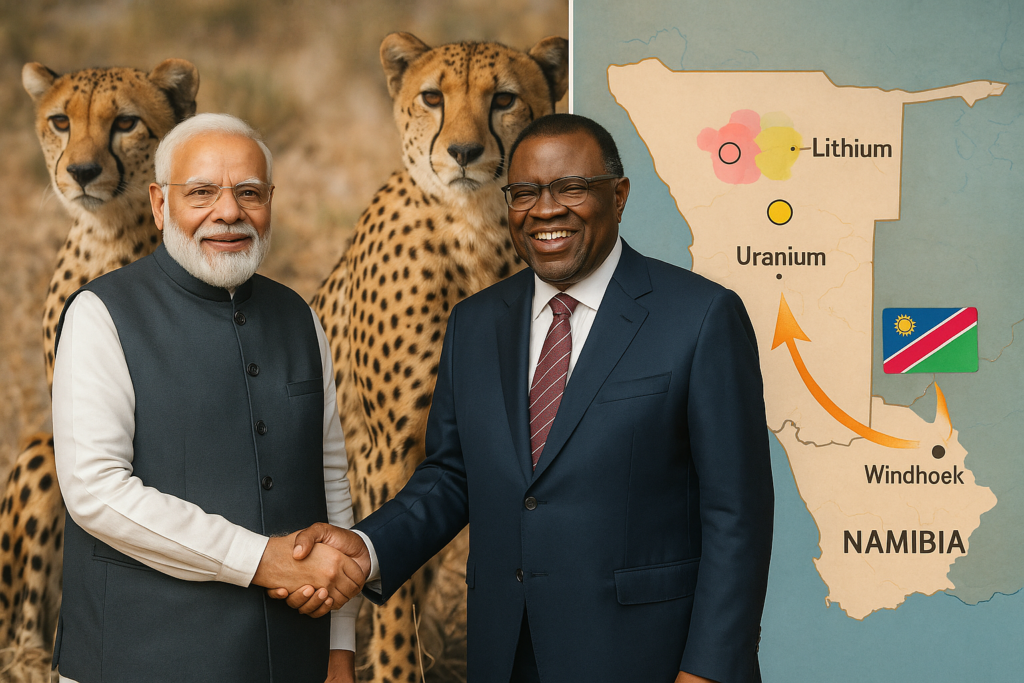
The final stop brings the tour full circle, back to Africa, but with a clear focus on the future. The visit to Namibia, the first by an Indian PM in 27 years, builds on a relationship that has recently captured global attention.
- The Story: The successful translocation of cheetahs from Namibia to India’s Kuno National Park was more than an environmental project; it was powerful wildlife diplomacy. Now, that goodwill is being leveraged for strategic gains.
- The Unexpected Turn: The discussions with President Netumbo Nandi-Ndaitwah will go far beyond wildlife. On the table are direct sourcing of Namibia’s rich deposits of diamonds, uranium, cobalt, and lithium—bypassing traditional trade hubs. Also on the agenda is the rollout of India’s UPI payment system, a significant step in exporting India’s digital public infrastructure.
- The Symbolism: PM Modi’s address to the Namibian Parliament will celebrate a shared history of struggle against colonialism while charting a new course based on resource partnership and technological collaboration.
As Air India One makes its way back to Delhi, it leaves behind a newly woven tapestry of alliances across the Atlantic. This five-nation tour was not a series of isolated visits but a single, interconnected strategic push. It circles back to the opening question: What is India’s place in the world?
By connecting with historical diasporas, securing future resources, and building coalitions on shared values, Modi is providing a clear answer. The tour is a declaration that India is no longer just a balancing power; it intends to be a leading one. The long-term success will depend on the follow-through of the agreements signed and the relationships forged, but the map of India’s global ambition has, in just eight days, been decisively and boldly redrawn.”


Leave a Reply